Weve been home a couple of months and the time has flown by. It took a couple of weeks to get settled back in Costa Mesa. During that time we had to contend with the the passing of Woody, our English Setter. It was a sad time around the house, but he lived to the ripe old age of 14 and certainly enjoyed a pretty good life.
As soon as that little ordeal was over we took a road trip to Vancouver, BC where we met up with friends for a cruise to Alaska aboard the MS Noordam. But before we boarded the ship, we spent a couple of days touring the city. One of the highlights of our tour was hiking up Grouse Mountain. The hike is known as the Grouse Grind, 2,800 feet of vertical ascent in about 1.8 miles. There are actually two ways to do the grind. The first and most commonly used route is the staircase, which consists of 2,830 stairs. It sounded kind of boring to us so we chose the secondary route, a trail through the forest. Both routes are unrelentingly steep climbs but you are rewarded with beautiful views of the city at the summit. For more information visit
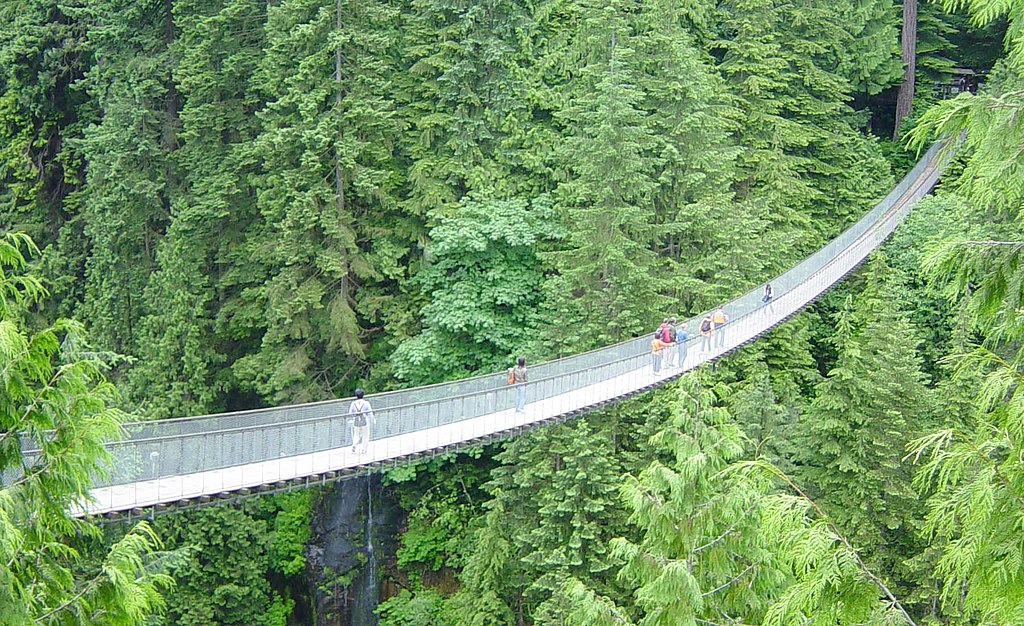
After hiking the Grind we made a side trip to the Capilano Suspension bridge.
We boarded the Noordam on Saturday morning, September 12th at the cruise ship terminal in downtown Vancouver.
The Noordam was built in Italy and christened in 2006. Here are some dimensions:
The ship is powered by a CODAG-Electric (Combined Diesel and Gas) system of diesel and gas turbine powered generators that drive Azipods instead of conventional propellers.
The diesel and gas turbine engines dont actually turn the propellers through shafts like a conventional boat, but drive large generators that supply power to the enormous electric motors encased in the Azipods. Pretty cool stuff.
After boarding the vessel and settling into our stateroom on deck 4, we went through a lifeboat drill while the crew cast off the dock lines and the Noordam puttered out into the channel. The stateroom was quite spacious, with a king size bed, sofa, shower/tub in the head and, best of all, the wall facing outboard was all glass, giving an excellent ocean view. Actually it was an excellent view of the 40 foot motorized lifeboat that was stowed just outside the glass, but we still had a pretty fair ocean view. Our first destination would be Juneau, Alaska, which we would reach on Monday around noon. To get there we transited most of the Inside Passage, which stretches from Washington state to Skagway.
 |
| DowntownVancouver viewed from the stern of the Noordam. The cruise ship terminal is the white structure on the left. |
 |
| Lions Gate Bridge, viewed from the bow of the Noordam. |
The Noordam headed northwest, passing under the beautiful Lions Gate Bridge and entered the Strait of Georgia, doing about 20 knots in fairly calm and balmy conditions. The Strait separates Vancouver Island from the mainland. It is about 150 miles long and varies between 11 and 34 miles wide. That sounds pretty spacious but it is actually full of islands and narrow channels, especially in the northern part of the strait. I was told that the Noordams crew includes three navigators, so the vessel trundled along at 18-20 knots night and day through the narrow parts as well as the wide parts of the channel.
The scenery in the Strait is beautiful. Evergreen forests cover the rugged terrain and surround the occasional small towns and villages on both sides of the channel. Whales were plentiful in this region and we saw orcas and what appeared to be humpbacks from the observation deck as well as from our stateroom.
 |
| Lighthouse near Vancouver. |
In the early hours of the next morning the Noordam passed into Discovery Passage, which is a narrow channel that connects the Strait of Georgia to Johnstone Strait by way of Seymour Narrows.
The Narrows is an interesting place for big ships, or small ones, because its about 3 miles long and averages about 750 yards wide. It is a place with strong currents, sometimes up to 15 knots.
 |
| Seymour Narrows with a rough approximation of the Noordams course. |
Unfortunately it was quite dark when we passed through the Narrows and I really couldnt see much of it. Back in the 1790s when Captain George Vancouver was exploring this region he is reputed to have described the narrows as "One of the vilest stretches of water in the world." There used to be a serious navigational hazard near the south end of the Narrows called Ripple Rock, which consisted of two submerged peaks rising to a depth of about nine feet below the surface. These rocks had quite a career, sinking 119 vessels between 1875 and the 1950s. By 1956 the government had seen enough of the Rock, so they spent over two years tunneling into it and packing it with 1,375 tons of high explosives. On April 5th, 1958 they blew it up. At that time it was the largest intentional, non-nuclear blast in North America.
The Noordam transited the narrows without mishap, and passed into the Johnstone Strait and then the Queen Charlotte strait, which carried us to the northern end of Vancouver Island and into Queen Charlotte Sound. The Sound is roughly 100 nautical miles long and is exposed to the Pacific Ocean, so the Noordam rolled just barely enough to feel it for about five hours. Then we were in the Hecate Strait which runs about 140 miles northwestward to Dixon Entrance. It averages about 45 miles wide and we seemed to be going right up the middle of it so there was little to see. The Noordam passed from Canadian to US territorial waters at the northwest end of Dixon Entrance.
We headed out toward the open sea from the Entrance and reentered protected waters at the southern tip of Baranof Island. From there it was another 150 nautical miles to Juneau by way of Frederick Sound and Stephens Passage. The Noordam tied up to the dock around noon and shortly after that we went ashore.
Juneau is the capital of Alaska and boasts a population of around 33,000 people. It is located on the mainland coast of Alaska but the surrounding terrain is so rugged that no roads have been built to the rest of the state, so the city must be supplied by boat or air. Most residents of Juneau work for the government, but there are lots of locals working in the tourist trade and fishing industries as well.
Instead of signing up with an expensive tour company our group of six hiked into town from the terminal and found a taxi driver that would take us out to see the Mendenhall Glacier and falls.
 |
| It was drizzling rain most of the time we were at Mendenhall, but the grandeur of the glacier was impressive anyway. In 1958 the glacier came right up to the trees in the foreground. Since then it has receded 1.75 miles, creating Lake Mendenhall. |
 |
| Growlers on Lake Mendenhall. It was here that I learned that a growler is a tiny iceberg that rises no more than 3 feet out of the water. A bergy bit is larger, rising 3 to 13 feet out of the water. |
 |
| Mendenhall Falls. |
By dusk we were back aboard the Noordam. Dinner aboard the ship was always a fun time. Our group, Wolf and Judy, Vic and Susan, and us always shared a table and usually had a pre-party in one of our staterooms. The food was consistently very good and we had each brought a couple of bottles of wine in our luggage, so the drinks were quite good as well.
The Noordam cast off at 2200 hrs. that night, bound for Skagway. It was a cold and overcast night and I was glad to be aboard a large and well heated ship instead of the Finisterra. The ship arrived around 0600 the next morning and we went ashore just after breakfast and boarded the narrow gauge White Pass/Yukon train. Its basically a tourist train that takes you directly from the dock to White Pass, which lies at an elevation of 2,865 feet. I couldnt help comparing it to El Chepe, the train that took us up to Copper Canyon in Mexico. The main difference is that there is no bar car on this train. We all agreed that it could use one. Aside from that, it was a pleasant ride up to the pass and the narrator who talked constantly over the loudspeaker was only a little bit annoying. The train was full of tourists snapping pictures of the passing scenery. Somehow it made me not want to take any photos myself.
The town of Skagway isnt much. It has a year round population of around a thousand souls, which doubles during the tourist season. It was founded in 1887 by one Billy Moore, who thought it would be a good jumping-off place for miners seeking gold. Sure enough, gold was discovered in the Klondike region of the Yukon Territory and miners flooded into Skagway. By 1898 the town had swelled to a population of around 9,000 and was the largest city in Alaska. That lasted a couple of years and by the turn of the century Skagways economy collapsed.
Nowadays tourism is the primary driver of the towns economy, with about a million tourists per year arriving, mostly by cruise ship. The few streets in town are lined with tourist shops, a few bars and restaurants, and not much else. We reboarded the ship in the afternoon, having seen pretty much all there was to see in Skagway. The dress code for dinner that evening was coats and ties for the men and dresses for the ladies. I hadnt worn a tie since I retired a couple of years ago, but the formal attire did not detract from the excellent steak and lobster that was served so I didnt grumble too much about it, and the women all looked beautiful as well.
The Noordam sailed for Glacier Bay while we were enjoying dinner. At dawn the next morning the ship came to a stop at the head of the bay and, using its rotatable Azipods and 7,500 horsepower bow thrusters, executed a 360 degree turn in place, so the passengers could all get a good look at the glaciers and sea life there. Earlier a ranger from Glacier Bay National Park had boarded the ship and she described the wonders of the region over the loudspeakers as the boat rotated. The bay is populated by fifteen glaciers, including Margerie, Grand Pacific, Johns Hopkins, and McBride.
 |
| Johns Hopkins Glacier deposits massive amounts of rock and debris into the bay. It is roughly 12 miles long, a mile wide and 250 feet high at the waters edge. It is one of the few in the park that is not receding. It travels at around 8 feet per day. |
 |
| The icy face of the Johns Hopkins |
 |
| For a chunk of floating ice to be officially categorized as an iceberg, it must rise out of the water at least 16 feet, with an overall thickness of 98 to 164 feet and cover an area of at least 5,382 square feet. These are bergy bits. |
The Noordam stayed in Glacier Bay until about 1800 hrs, then headed southeast toward Ketchikan, arriving at 1000 the following morning. Wed heard that there were lots of bears here and the shipboard tour company as well as a dozen or so tour operators on the dock were most anxious for us to see them. They were shouting at the tourists as we came off the ship offering special prices and guaranteeing that wed see bears and eagles up close and personal for only a hundred dollars per person. They all seemed disappointed in us because we failed to take advantage of their offers.
Instead, we wandered down the street and found a taxi van whose driver who looked like he was doing nothing but texting on his I-phone, so I approached him and we struck a deal. For $140 bucks hed take us to Herring Cove, where the bears go to catch salmon and pose for the tourists. He turned out to be an amiable sort and spent three hours with us while we lingered at the cove watching the occasional bear emerge from the forest a couple of hundred yards away. The best part of the excursion was hearing his stories of his life in Ketchikan. After an hour or so, the place started filling up with tourists so our driver took us back to town, stopping to show us various points of interest, which were not many, along the way. It was a pretty good tour at a bargain price.
Ketchikan is fairly cosmopolitan compared to Skagway, with a population of over 8,000. Many Ketchikanians fly south for the winter, but our driver stays on. He said its much more peaceful after the hubbub of the tourist season dies down. I believe him.
We sailed from Ketchikan around 1800 hrs. bound for Vancouver. The weather forecast was for strong southerly winds and the ship veered away from a direct course and we sailed through a labyrinth of narrow channels instead of bucking bigger seas in Queen Charlotte Sound. The Noordam arrived in Vancouver at 0700 Saturday morning and we were back at Wolf and Judys home by noon where we played Mexican Train all afternoon.
The next day we visited friends Howard and Lynn at their flat on the 33rd floor of the Shaw building in downtown Vancouver. The views from their balcony were breathtaking. By mid-afternoon on Sunday we were back on the road, headed south. I wanted to get past Seattle to avoid the traffic gridlock that usually plagues the I-5 freeway between Lynnwood and Tacoma on weekdays, so we didnt stop until we got to Olympia.
We got back on the road around 10:00 the next morning and headed south at a leisurely pace. The plan was to check out a few wineries between Portland and Corvallis in the early part of the day, then visit Lisas alma mater, Oregon State University. With football season in full swing she needed a new flag and some flannel pajama bottoms with the OS logo on them. Shes still an avid fan of the fighting Beavers. Unfortunately, they arent doing too well this year, with a 2-2 record. She has high hopes for the upcoming game against Arizona though.
 |
| Its harvest time in the Willamette Valley. |
We wanted to visit Crater Lake on this trip so from Corvallis we drove to Roseburg, where we spent the night. We had an excellent dinner at Dinos Italian Ristorante and chatted with our waitress who was a student at Umpqua Community College. As we drove back to our hotel we remarked on what a sweet small town Roseburg is, unaware of the tragedy awaiting the people here. Our hearts are grieving for them. Its obvious that no amount of senseless carnage is going to change the minds of people who treasure their guns and would rather continue on the path of killing than adopt reasonable gun laws. Its a uniquely American malady that we will probably only cure when we discover a cure for stupidity.
We turned off of I-5 in Roseburg and drove for miles along the beautiful Umpqua river. We stopped occasionally to wander along the banks of the river, where we spotted the occasional fisherman standing on a rock in midstream, fly rod in hand. Idyllic scenes. We arrived at Crater Lake a little before noon and spent the afternoon hiking and enjoying this pristine natural wonder.
 |
| Photos cant quite capture the beauty of this lake. |
 |
| Wizard Island |
The lake was created when a volcano named Mt. Mazama collapsed in on itself around 7,700 years ago, creating a caldera or bowl over 4,000 feet deep in the middle where the peak used to be. Over time, rain and snowmelt filled the bowl, creating the lake. No rivers or streams flow into the lake so its only source of water is rain and snow. Over the next several hundred years there were more eruptions within the caldera, creating several cinder cones, one of which eventually rose out of the water and became Wizard Island.
 |
| There is a crater in the top of Wizard Island. |
We got back on the road in the late afternoon and continued south, spending a night in Redding, California before heading up into the Sierras to visit family in Nevada City. Its always fun to hang out with Brian and Karen at their beautiful home nestled in the hills above the town. We stayed long enough to spend a day soaking up sunshine as we floated on tubes in the Yuba River, then got back on the road.
We drove south to Paso Robles where we spent the night and did some wine tasting in the surrounding area, and picked up some wine that had been waiting for us since last November. From there we headed home, arriving around 9:00pm, all safe and sound.
 0
comments
0
comments